
Troup County Criminal Docket Searches
Start with the issuing court, not a broad name search. The Superior Court criminal calendar and State Court criminal calendar publish separate PDF groups. They are useful when the court and setting type are known. The clerk's Case Search route may lead to a credential screen, so it is not safe to assume that every visitor can open a full case history online.
Gather the court name, case number if known, offense year, and the date on the latest notice. A name alone can match more than one file. The official sources do not publish a Troup criminal case-number grammar or anonymous sample docket, so do not guess a number format. Use the combined Clerk of Superior and State Courts for a file-level request.
- Identify Superior, State, municipal, Magistrate, or Juvenile Court.
- Open the correct official calendar and choose the newest relevant PDF.
- Compare the case number and setting with the latest notice or order.
- Call the clerk at 706-883-1740 when a date or entry is unclear.
- Request the public docket or a certified filing when proof is needed.
Two Troup Criminal Calendars
Troup County uses one combined Superior and State clerk, but the criminal calendar paths remain distinct. Superior Court carries felony and other serious criminal matters in the Coweta Judicial Circuit. State Court handles misdemeanors and traffic within its authority. That split changes which PDF, clerk desk, and setting label a searcher needs.
| Court | Typical docket | Published labels |
|---|---|---|
| Superior Court | Felonies and serious criminal matters | Pretrial, arraignment, motions, MNT, jury, VOP, add-on |
| State Court | Misdemeanors and many traffic cases | Pretrial, bench trial, jury, arraignment, motions, non-English arraignment |
| Municipal Court | City citations and ordinances | Varies by LaGrange, West Point, or Hogansville |
A city citation does not automatically appear in the county criminal calendar. Check the issuing agency before calling the county clerk. Magistrate warrant work and restricted Juvenile Court matters also follow separate custodian routes.
Criminal Dockets: What They Show
A criminal docket is an event index, not a full narrative. When public, it may identify the case, filed charge, scheduled events, motions, orders, plea, and disposition. A calendar gives a smaller slice: it mainly shows that a matter was set for a certain event. Neither source should be used to infer guilt, a live warrant, or the final result without checking the later entries and filed orders.
| Case number | The court's file identifier; use the exact number supplied by the clerk. |
|---|---|
| Charge | The alleged offense and amendments, subject to the filed charging paper. |
| Setting | Arraignment, pretrial, motion, bench trial, jury, or revocation date. |
| Plea | A recorded plea entry, which must be read in sequence with later events. |
| Disposition | The court's outcome entry, supported by the final order or sentence. |
For an official result, request the disposition or judgment itself. A certified copy is authenticated by the clerk and differs from a calendar printout or informal screen capture.
Troup Criminal Calendar Codes
The clerk's file names use short labels that describe calendar categories, not case outcomes. Local orders can add or remove these dates. Read each abbreviation with the court and document date.
- MNT
- Motion for new trial, a post-trial motion category shown on Superior criminal calendars.
- VOP
- Violation of probation or probation-revocation setting.
- Add-on
- A date or matter added to a calendar; it is not proof of a new charge.
- Pretrial
- A setting before trial whose exact purpose must be confirmed from the case.
- Arraignment
- The formal plea-stage setting, with a separate non-English arraignment label on State Court lists.
Georgia's official sources did not provide a Troup charge-code list. Ask the clerk about unfamiliar text rather than expanding it from a third-party database.
Criminal Case Stages on the Docket
A Troup County criminal docket may begin with a filed accusation, indictment, or other charging entry, depending on the court and case. Arraignment records the formal plea stage. Pretrial events can include discovery issues, motions, conferences, and readiness settings. A plea may resolve the case, or the record may progress to a bench or jury trial. Later entries can include sentence, dismissal, appeal activity, probation matters, or a motion for new trial.
Docket flow: Filing › Arraignment › Pretrial › Plea or Trial › Disposition › Sentencing
The path is not always linear. A continuance moves an event, while a dismissal ends a charge or case only when the docket and filed order say so. A later order may replace an earlier setting.
When Troup Criminal Dates Move
The Troup local orders index documents schedule changes that a static calendar may not reflect. Recent categories include removed criminal jury weeks and added grand-jury, VOP, and MNT dates. The clerk also warns that calendar additions and deletions occur.
Verify a changed date. Compare the newest calendar and local order, then call the responsible clerk before appearing. A prior PDF is not final notice.
Keep the case number and written notice at hand. Ask whether the new date is a reset, continuance, add-on, or replacement setting. Each term can affect the next required step.
Troup County Criminal Docket Courts
The Troup Clerk of Superior and State Courts keeps the principal county criminal files. Superior Court handles felonies. State Court handles misdemeanors and traffic matters within its jurisdiction. The shared clerk counter is at 100 Ridley Avenue, Suite 1600, LaGrange, and the main number is 706-883-1740. The county directory also lists State Court at 706-883-1727.
LaGrange, West Point, and Hogansville retain municipal citation and ordinance dockets. A county calendar search can fail simply because the ticket belongs to a city. Magistrate Court handles limited criminal and warrant work through its own office. Juvenile proceedings use a separate court and are generally restricted from ordinary public inspection.
Troup Criminal Clerk Access
Online access is only one channel. If the Case Search route stops at an Icon or PeachCourt login, call the combined clerk, visit the Government Center counter, or ask about the authorized public terminal in the first-floor Jury Assembly Room. The clerk can also explain copy, certification, transcript, and appeal-record charges.
The clerk announcements page illustrates why custodian confirmation matters. It contains record and filing notices that do not belong to a single case calendar.
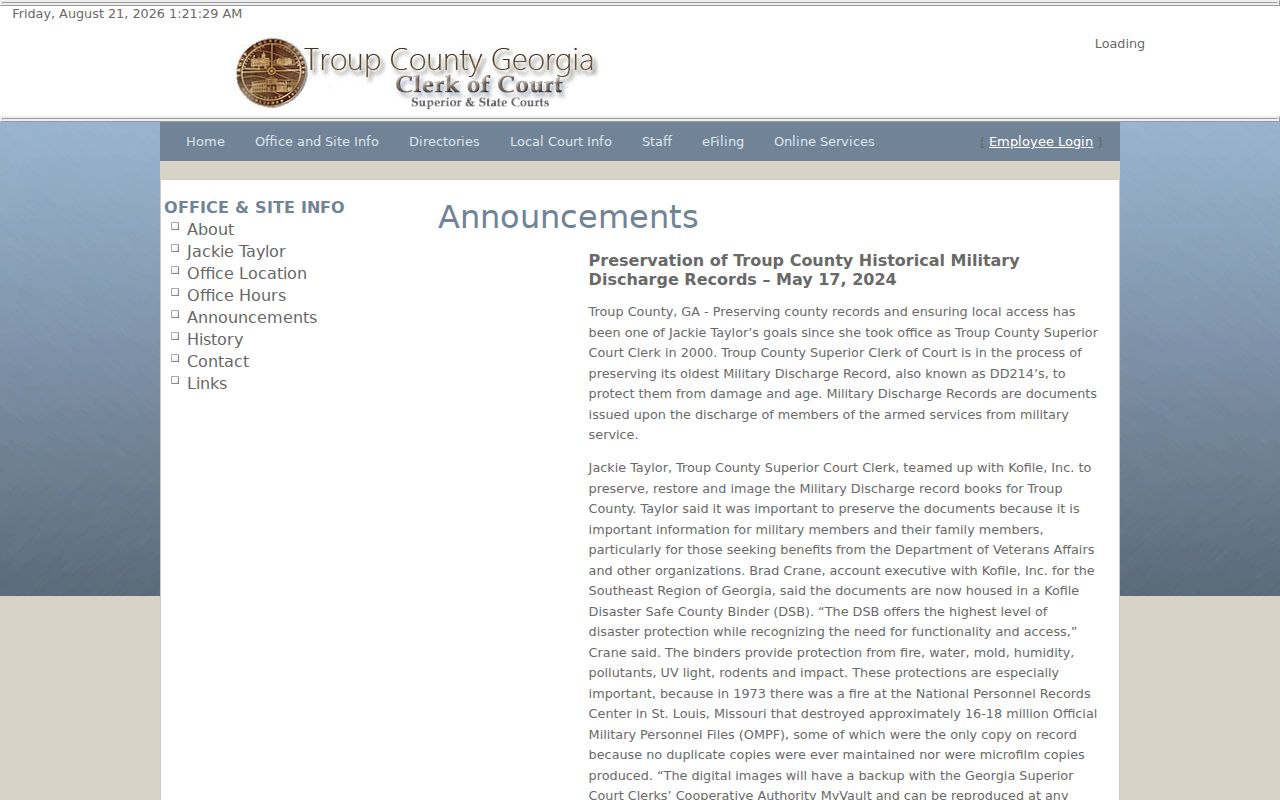
These office-wide notices supplement, but do not replace, a criminal docket request tied to a court and case number. A precise request should identify Superior or State Court, the exact case number, the requested filing, and whether a plain or certified copy is needed. For a hearing date, ask for the latest setting and any later order that changed it. For an outcome, ask for the disposition entry and final filed order. Those details help the clerk distinguish a calendar question from a document request.
Troup State Criminal Calendar
The official State Court calendar list separates annual and dated files for pretrial, bench trial, jury trial, arraignment, motions, and non-English arraignment.
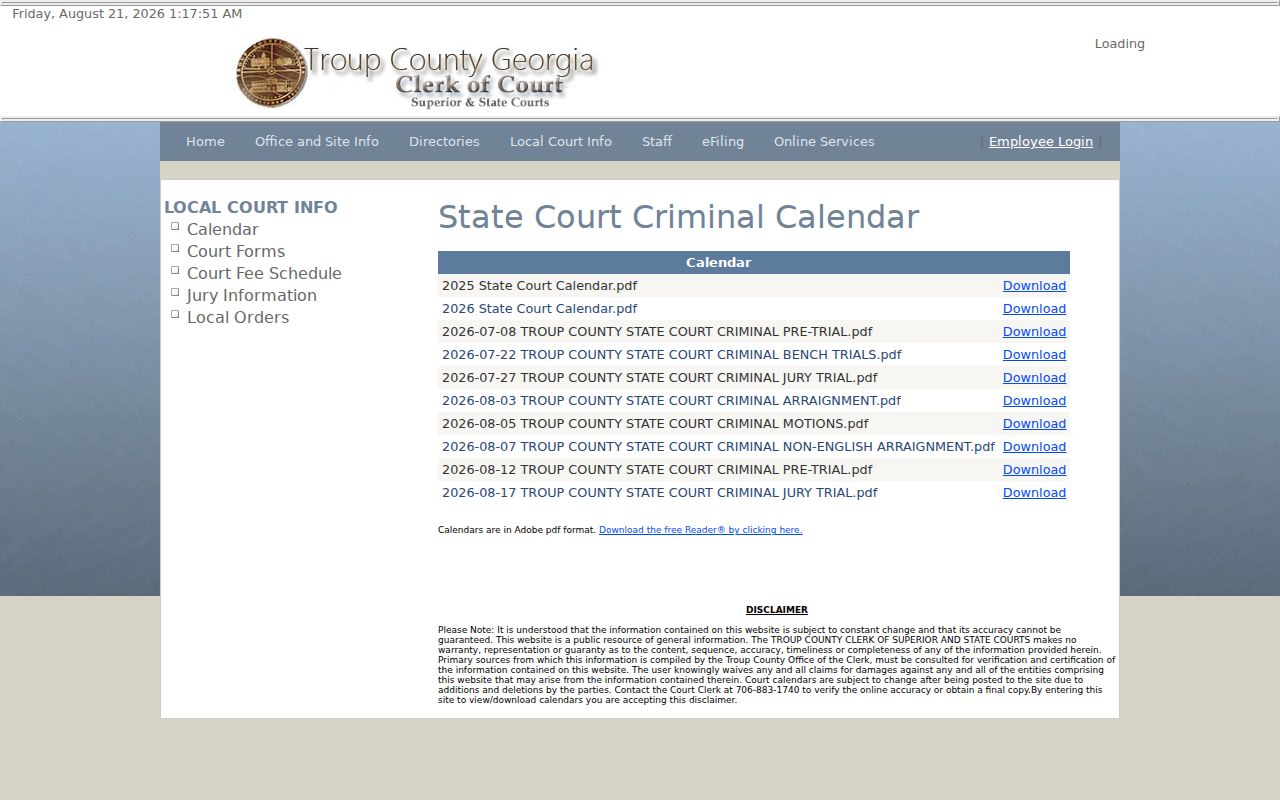
Choose by setting type and date, then confirm the case with State Court or the combined clerk. A listing shows a scheduled event, not whether it occurred or how the case ended.
Troup Superior Criminal Calendar
The Superior criminal calendar index includes pretrial, arraignment, motions, motion-for-new-trial, jury, probation-revocation, and add-on material.
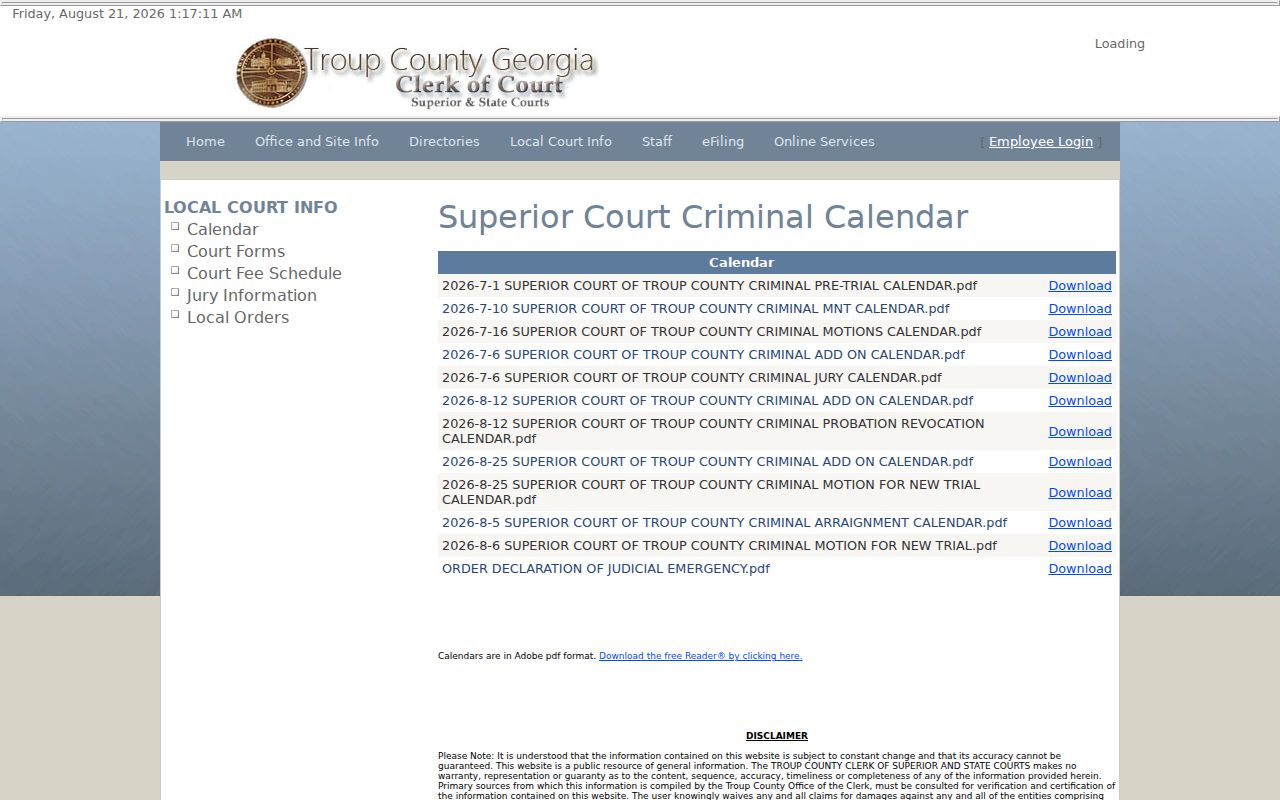
The category list helps narrow a search, but a filed order remains stronger evidence of the current setting or final disposition. Superior Court is part of the Coweta Judicial Circuit, so a circuit calendar may give context without replacing the Troup criminal file. Confirm that the PDF names Troup County, the correct setting type, and the right date. Then compare it with local orders when a jury week, VOP date, motion date, or add-on calendar may have changed.
Access Rules for Criminal Dockets
Georgia Superior Court records generally begin with public access, but a statute or court order can restrict part or all of a file. Protected identifiers may be redacted. Juvenile records are not open to ordinary inspection except through the access routes set by law. A missing online result is not proof that a matter is sealed.
Key Rules:
Uniform Superior Court Rule 21 starts from public access and sets the process for restricting records.
Georgia Open Records Act governs county-held public records but does not override a sealing order or court-specific restriction.
O.C.G.A. §15-11-708 limits ordinary public inspection of juvenile records.
Ask the clerk for the public portion and the legal basis for any withheld material. For proof, request the specific filed order, judgment, or certified docket entry rather than relying on a calendar alone. Troup County clerk confirmation closes the gap between an online lead and the maintained criminal record.