
Troup County Court Record Requests
Begin with the court, not merely the county name. The Clerk of Superior and State Courts keeps those two courts' civil and criminal files. The county-linked Case Search can help locate a case, while the Georgia E-Access directory lists PeachCourt as a provider for Troup Superior and State Courts. Neither route replaces the clerk when a document image, certified judgment, older file, or access ruling is needed.
Troup County court records may also be requested at the clerk's counter, by mail, or after calling 706-883-1740 to confirm the custodian and current copy process. The counter is in Suite 1600 at 100 Ridley Avenue, LaGrange, Georgia 30240, and published hours are 8:00 a.m. to 5:00 p.m. on weekdays except legal county holidays. A first-floor personal-access terminal is available in the Jury Assembly Room lobby. For court records held by another court, contact that court directly.
- Name the exact court, case number, parties, and document date.
- Choose the Case Search, state provider directory, public terminal, counter, phone, or mail route.
- Tell the custodian whether a plain, certified, exemplified, or electronic copy is needed.
- Confirm the page count, fee, accepted payment, and delivery method before sending funds.
- Ask for the redacted public portion if a complete file cannot be released.
Troup Court Custodians Differ
One elected clerk does not hold every Troup County court record. Jackie W. Taylor's office combines Superior and State Court custody. Magistrate Court keeps small claims, dispossessory, garnishment, and its criminal work. Probate Court keeps estate, will, guardianship, conservatorship, marriage-license, and weapons-license records. Juvenile Court maintains juvenile cases under tighter access rules. LaGrange, West Point, and Hogansville each retain their own municipal citation and ordinance records.
The county's administrative open-records officer is also distinct from a court custodian. Use the Troup County Open Records form for county administrative records. It lets a requester choose inspection and copying or copies only, describe the item, acknowledge fees, and select the statutory response window or a requested date. A pleading or judgment should go to the clerk of the court that filed it. Routing it as a general county request can add delay.
- Court custodian
- The clerk or office that maintains the judicial file.
- Open records officer
- The county contact for executive and administrative records, not a substitute for each court clerk.
Kinds of Troup Court Records
A docket is the event index, while a case file holds the papers behind those entries. A useful Troup County court record request names the precise item. That might be the final judgment needed to prove the outcome, the return of service needed to show delivery, or an order that explains why a date changed. Broad requests can cost more and take longer because the clerk must locate and copy more pages.
- Case indexes, docket sheets, captions, and event histories
- Complaints, petitions, answers, counterclaims, indictments, and amendments
- Temporary, scheduling, final, dismissal, sentence, and transfer orders
- Summonses, subpoenas, service returns, garnishments, and dispossessory papers
- Transcripts, exhibits, audio when maintained, and trial orders
- Probate, Magistrate, Juvenile, municipal, plat, and military-discharge records
Troup Specialty Record Counters
The official Troup Magistrate Court page lists its separate civil and criminal contacts. The official Probate page likewise shows that probate work has its own office and jurisdiction. These are strong signs that a broad search of the Superior and State Court system cannot be treated as a complete countywide record search.
View the official Troup Probate Court source used for this court-record route.
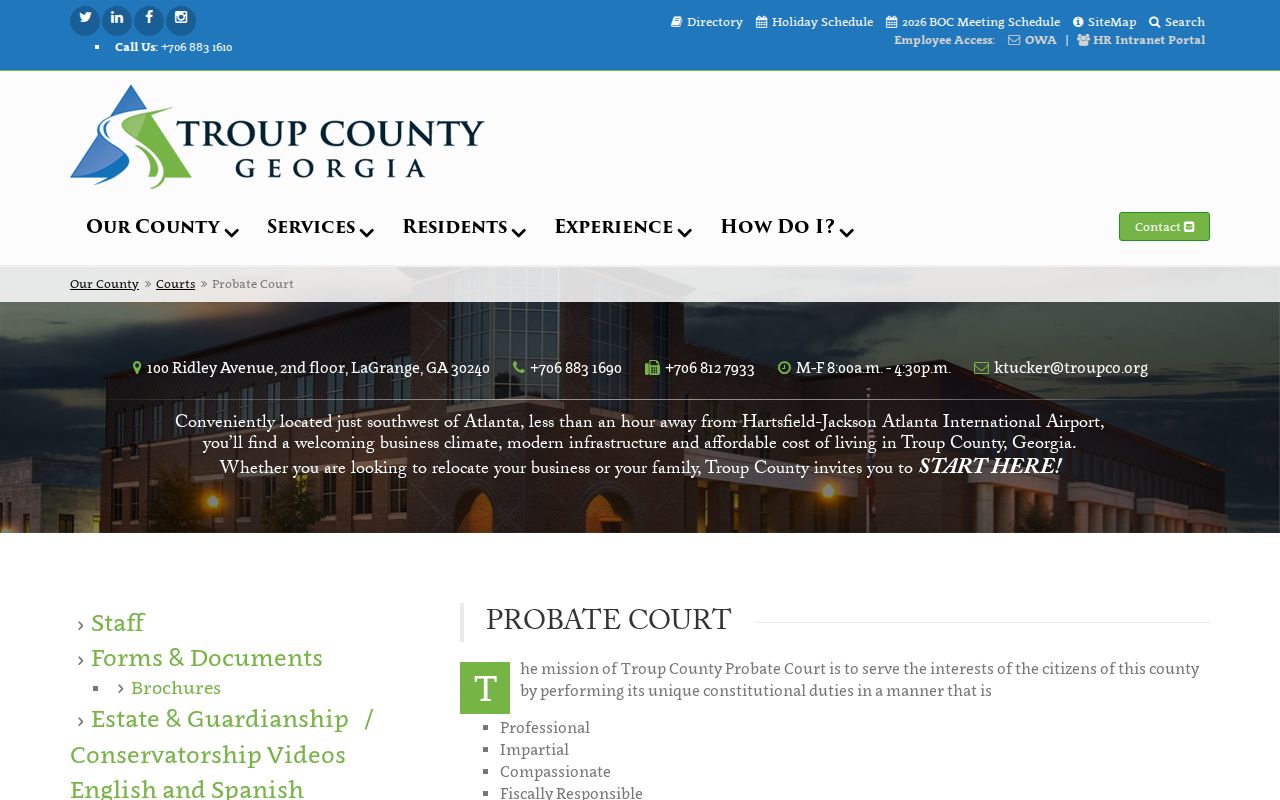
The captured page ties estate and related probate requests to Probate Court rather than the combined Superior and State clerk. The same routing rule applies to Magistrate and Juvenile records: contact the office that owns the file and ask what part is public.
Note: A missing result in one Troup County system does not prove that no record exists in another court.
Troup DD214 Access Boundary
The clerk's 2024 preservation announcement describes work on old DD214 military-discharge record books. Pages were restored and imaged, digital backups went to GSCCCA MyVault, and disaster-safe binders preserved physical copies. That project is a local milestone in Troup County record care. It also shows why digitization and public release are separate questions: the same notice says these DD214 records are not open to the general public.
A general court record request should not demand protected discharge papers. A person seeking an eligible DD214 copy should contact the clerk and ask what relationship, identification, or authority must be shown. The public cannot infer access from the fact that the books were scanned. For other partly restricted files, ask whether a redacted public copy can be produced without disclosing protected identifiers.
Court Records: What They Contain
Troup County has not published a dependable case-number grammar or a full public sample result from its current Icon login surface. Do not guess a year, court code, or sequence from a partial number. Give the clerk the number exactly as printed and add party names and a filing date when known. The docket can point to a filed item, but the filed document supplies its text, signatures, and legal effect.
| Case Number | The court's exact identifier; local public format rules are not published. |
|---|---|
| Pleadings | Petitions, complaints, answers, motions, and amendments filed by parties. |
| Orders & Judgments | Signed rulings, sentences, dismissals, and final results. |
| Docket Sheet | A dated event history that indexes filings, settings, and court action. |
| Process | Summonses, subpoenas, returns, and proof of service. |
| Exhibits | Attachments or evidence accepted into the file, subject to access limits. |
Request the Troup Judgment
A docket entry may say that judgment was entered without showing all terms. When proof of the result matters, request the signed final judgment, dismissal, sentence, or disposition instead of relying on the event line. State the document name and date if the docket provides them. This narrows the copy job and helps the Troup County clerk distinguish a final order from a proposed order, minute entry, or scheduling notice.
Transcripts require another level of care. The Troup County fee schedule includes transcript-submission and copied-transcript charges, but the official sources do not publish a complete transcript-order workflow. Ask whether a court reporter or the clerk holds the requested material, whether it already exists, and what estimate applies. Do not assume that audio, exhibits, or a transcript is available just because a hearing appears on the docket.
Copy Fees and Certification
An uncertified copy reproduces the file. A certified copy adds the clerk's attestation that it is a true copy from the court record. An exemplified copy carries added authentication and costs more. Ask the recipient which form it requires before ordering. The Troup clerk fee schedule lists the following Superior and State Court charges; it should not be applied to Probate, Magistrate, Juvenile, or city records without confirmation.
| Item | Amount |
|---|---|
| Uncertified copy, per page | $0.50 |
| Certified copy, first page | $2.50 |
| Certified copy, each added page | $0.50 |
| Exemplified copy, first page | $5.00 |
| Computer printout, per page | $2.50 |
| Fax or electronic copy, per page | $1.00 |
Clerk of Superior and State Courts
100 Ridley Avenue, Suite 1600
LaGrange, GA 30240
706-883-1740
Troup Copy Payment Rules
The published schedule says filing fees may be paid by company check, cashier's check, or money order to Jackie W. Taylor, and it says no personal checks. A copy request may have its own counter or mail instructions, so confirm the amount and payment form before sending anything. The sources do not publish a complete certified-copy-by-mail form, identification rule, online order button, document-view charge, or fulfillment time.
Those gaps matter. A mailed request should include the exact court, case number, party names, document title, desired certification level, return address, and a phone number for questions. Ask whether a self-addressed envelope is needed and obtain a fee quote. If a record is long, request an estimate or inspect it first. Troup County's general open-records form acknowledges possible fees, but it does not turn an administrative request into a court-copy order.
Access Rules for Court Records
Georgia starts from public access to court records, but access may be limited by law or a court order. A portal login, broken link, or absent image does not by itself mean a Troup County case is sealed. Ask the custodian whether the file is paper-only, held by another court, temporarily unavailable, redacted, confidential, or subject to a sealing order. When only part is protected, request the separable public portion.
Juvenile matters, protected identifiers, adoption-related material, and some health or treatment records can have special limits. Troup's preserved DD214 military-discharge files are also not open to the general public. The clerk's 2024 preservation notice describes imaging and backup work, yet that technology project did not remove the access boundary. A person entitled to a restricted record should ask the custodian what proof or court authorization is required.
Key Rules:
Uniform Superior Court Rule 21 sets the process and findings required to limit public access to a Superior Court record.
Georgia Open Records Act, O.C.G.A. § 50-18-71 governs inspection and copying of public records, while judicial files remain with their court custodian.
Georgia judicial-security protections shield specified personal information and do not make every filing in a case secret.