
Troup County Civil Docket Searches
The official Troup civil calendar is the clearest open starting point for a known setting. It groups Superior non-jury, jury, add-on, judge-specific, and State Court civil files. It does not offer a name or case-number search box. The clerk's Case Search and PeachCourt paths may require credentials, so a visitor should plan for clerk help rather than treat a login screen as a denial of public access.
Collect the court, exact party names, case number if known, filing type, and a date range. Troup does not publish a verified public civil case-number grammar. Copy the identifier exactly from a notice. The combined Clerk of Superior and State Courts can distinguish the docket index from the document itself.
- Identify Superior, State, Magistrate, or municipal court.
- Check the current civil calendar and local orders.
- Try the official Case Search or PeachCourt route if authorized.
- Call 706-883-1740 or visit the clerk counter for Superior and State files.
- Request the named pleading, order, judgment, or certified copy needed.
Troup Civil Calendar Categories
The clerk publishes several civil calendar tracks because a single list would blur meaningful differences. Superior non-jury dates cover bench trials or hearings. Jury files cover trial weeks. Add-on dates reflect matters added to a calendar. Judge-specific files help narrow a setting, and the State Court list includes both civil and peremptory calendars.
The civil calendar index shows these categories and links to their PDFs.
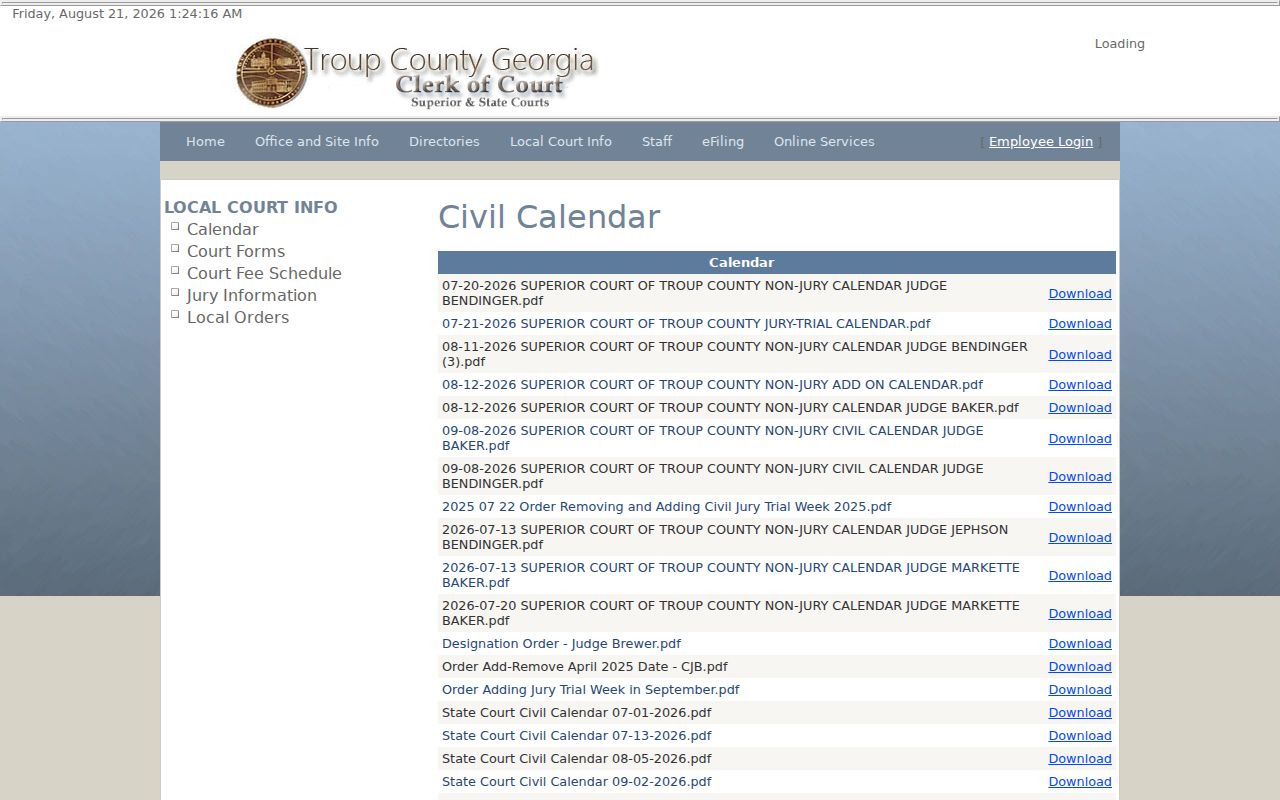
The index is a routing tool. Confirm the newest date against the case docket, filed scheduling order, and clerk because additions and deletions can occur. A judge-specific calendar is not a full inventory of that judge's cases. A peremptory or add-on list also does not reveal the substance of a motion or judgment. Record the PDF title and date, then ask whether a newer calendar or order controls.
Civil Dockets: What They Show
A civil docket is the chronological index for a case. It can identify parties and show when a complaint, answer, motion, return of service, order, or judgment was entered. The public calendar is narrower. It shows a scheduled event and may omit the filed papers that explain the dispute. A docket entry also differs from a certified judgment, which the clerk authenticates for official use.
| Case number | The court's exact file identifier; no local public format was verified. |
|---|---|
| Parties | The named litigants, subject to redaction or restriction. |
| Filings | Complaint, petition, answer, counterclaim, return, and amended papers. |
| Motions | Requests to the court and related orders or hearing dates. |
| Judgment | Final judgment, dismissal, default, or other disposition entry. |
PeachCourt Civil Filing Route
Troup County's e-filing instructions route civil and domestic attorney filings initiated on or after January 1, 2019 through PeachCourt, subject to the local exceptions and rollout history. PeachCourt is filing infrastructure. Its account screen is not proof of an anonymous public docket search.
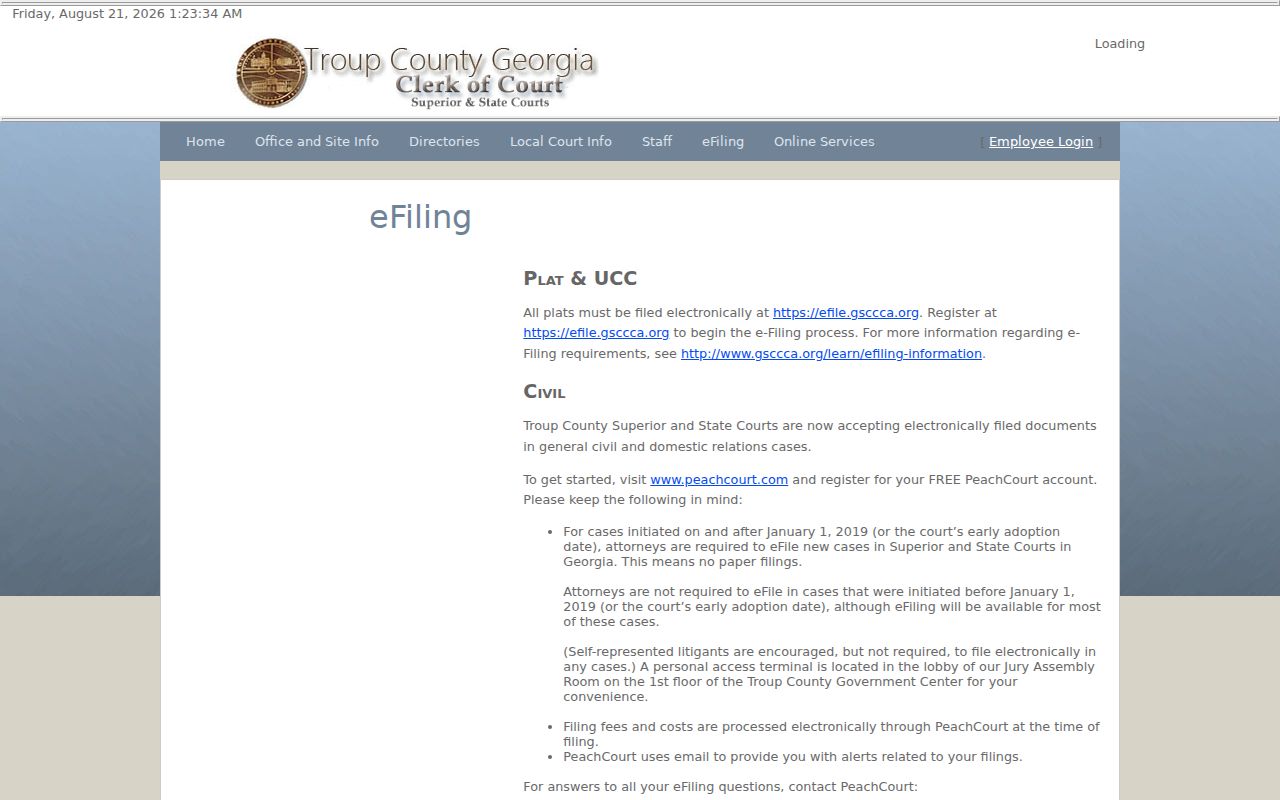
The same clerk page points to a public terminal in the first-floor Jury Assembly Room. That creates a practical fallback when remote access stops at login: call first, then ask whether the terminal or clerk counter can provide the public index or named filing.
An attorney filing account, a public calendar, and clerk-assisted access can expose different parts of one matter. PeachCourt may carry documents for an authorized user, while the open calendar shows only a setting. A person seeking the complaint, answer, motion, or judgment should name that document. This helps separate an index entry from the paper filed with the court.
What Cases Fill the Civil Docket
Troup civil matters are divided by subject and court authority, not by one simple online filter. Superior Court handles civil and domestic matters within its jurisdiction. State Court describes civil actions regardless of amount unless Superior Court has exclusive jurisdiction. Magistrate Court has a separate clerk and handles many limited civil and process matters. Municipal courts keep separate non-criminal municipal dockets when such actions arise.
- Superior civil, domestic, and protective-order matters
- State Court civil cases outside Superior's exclusive authority
- Magistrate claims, dispossessories, garnishments, and process
- Repossession, foreclosure, levy, and interrogatory filings listed by Magistrate
- Municipal non-criminal matters kept by the issuing city
No official source found in the research gives a simple local dollar cutoff between State and Magistrate civil dockets. Confirm the correct filing route with the clerk instead of relying on a generic Georgia summary.
Troup Magistrate Civil Records
Dispossessory, garnishment, small-claims-type, repossession, foreclosure, levy, and related process matters use the Magistrate Court route. The office is at 100 Ridley Avenue, Suite 1800, and its listed number is 706-883-1695. No public online Magistrate docket was located in the official source sweep.
| Record need | Likely custodian | Practical route |
|---|---|---|
| Superior or State civil case | Combined Superior/State clerk | Calendar, clerk phone, counter, terminal |
| Dispossessory or Magistrate claim | Magistrate clerk | Call or visit Magistrate Court |
| Service or eviction process | Court file plus Marshal return | Ask for the filed return, not just process status |
The Marshal's Civil Division serves process, garnishments, subpoenas, and evictions, but it is not the principal docket-search counter. A service return becomes useful when it is filed in the correct court case.
Hearings on the Civil Docket
A civil setting may be non-jury, jury, peremptory, judge-specific, or add-on. These labels are not interchangeable. A peremptory calendar calls matters for action on a set date. An add-on label means the court placed a matter or date on a calendar; it does not reveal the requested relief or result. Read the underlying notice or scheduling order.
Check the newest PDF, then review the local orders page for added or removed dates. The broader Troup County court schedule explains how to compare calendar sources. Call the clerk if a docket entry, party notice, and PDF conflict.
Troup Civil Fees and Service
The Superior and State clerk fee schedule lists a $218 starting charge for a civil or domestic filing without sheriff service. Sheriff service is listed separately at $50. Those figures describe filing and service, not a stated public docket-search fee. Copy, certification, exemplification, transcript, and electronic delivery charges can differ.
| Item | Published amount |
|---|---|
| Civil or domestic filing without sheriff service | $218 |
| Sheriff service | $50 |
| Civil or domestic subpoena | $5 |
Confirm the current total before filing or ordering a copy. The correct amount can depend on service, page count, certification, and the exact court. The schedule distinguishes ordinary, certified, and exemplified copies, electronic delivery, computer printouts, oversize pages, and transcript work. State the product needed and ask for a current estimate before sending payment.
Troup Civil Forms Index
The official court forms index includes civil materials such as garnishment forms and points readers toward approved court documents.
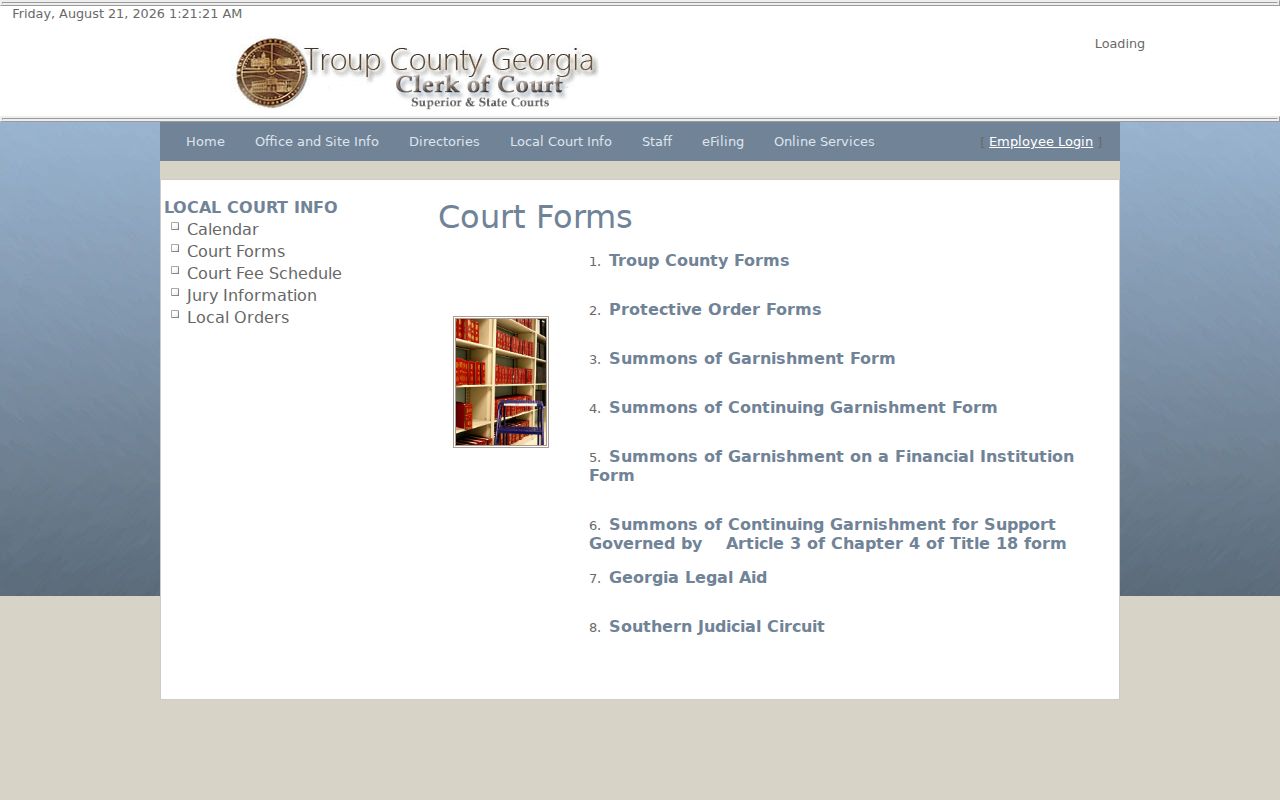
A blank form is not a filed case record. Once submitted and accepted, its docket entry and filed version belong to the court file. Ask the clerk for that filed copy when the contents matter.
Certified Troup Civil Judgments
A calendar can show that a hearing was set, but it cannot establish the text of a judgment. Request the exact judgment, order, or dismissal by court, case number, document name, and filing date. State whether a plain or certified copy is needed. Certification is the clerk's authentication that the copy matches the maintained record.
Use the right record. For proof of an outcome, obtain the filed judgment or order. A calendar listing and a docket index are only leads.
If a document is not visible through PeachCourt, contact the custodian. The sources do not publish a complete mail-order form, identification rule, turnaround time, or online document-view price, so those details must be confirmed directly.
Who Can See Civil Dockets
Georgia Superior Court files generally start as public, but a court order or law may restrict access. Family-violence and stalking records can contain protected identifier pages. Juvenile matters use separate statutory limits. A portal login, missing PDF, or inaccessible vendor does not prove that a civil case is sealed.
Key Rules:
Uniform Superior Court Rule 21 sets the public-access baseline and procedure for restrictions.
Georgia Open Records Act provides an access and response framework for county-held public records.
Georgia open-government guidance explains exemptions and the need for a legal basis when records are withheld.
Always send court-file requests to the court custodian. The county Open Records form is useful for county administrative records, but it cannot override a sealing order or court rule. Ask for any reasonably separable public portion and request the specific basis for a denial. Troup County clerk confirmation remains the final access step. Keep the request narrow by naming the court, case, filing date, and exact civil document sought.